Where the Garden Would Be: A Winter Windowsill Plan for Small Flats

Photo: Mick Garratt, CC BY-SA 2.0, via Wikimedia Commons
At No. 67, the front window is a single sash, the sill is barely a hand-span deep, and the flat is rented. There is no garden. There is no balcony. There is a ledge, and between November and February it becomes the most useful square metre in the place.
It is also the square metre most likely to end up with a puddle under a pot and a mushroom-coloured patch on the paintwork. So this is not a styling piece about arranging things prettily on a sill. It is a winter plan: condensation first, light second, living things third, and a five-minute Sunday ritual to keep the whole thing from turning into a damp little cautionary tale.
The glass comes before the styling
Cold glass plus warm, moist indoor air equals condensation. That is the whole science of it. The water has to go somewhere, and if it goes into a wooden sill, a paperback or the back of a picture frame, you will smell it before you see it.
Renter-friendly rules, then. Keep every pot on a saucer or a mat, never directly on the sill. Leave a finger-width gap between leaves and glass so air can move. Wipe the glass and the sill with a dry microfibre cloth every morning if the window is streaming — it takes twenty seconds. Open the window for two minutes after a shower or a long cooking session. Do not block the trickle vents. And if the sill is painted, a small wool felt mat underneath the whole arrangement is cheaper than repainting.
I learned this the dull way: a hyacinth in a pretty ceramic pot, no saucer, a cold snap, and a ring on the paint that is still there. The plant was fine. The sill was not.
Layer the light, not the clutter
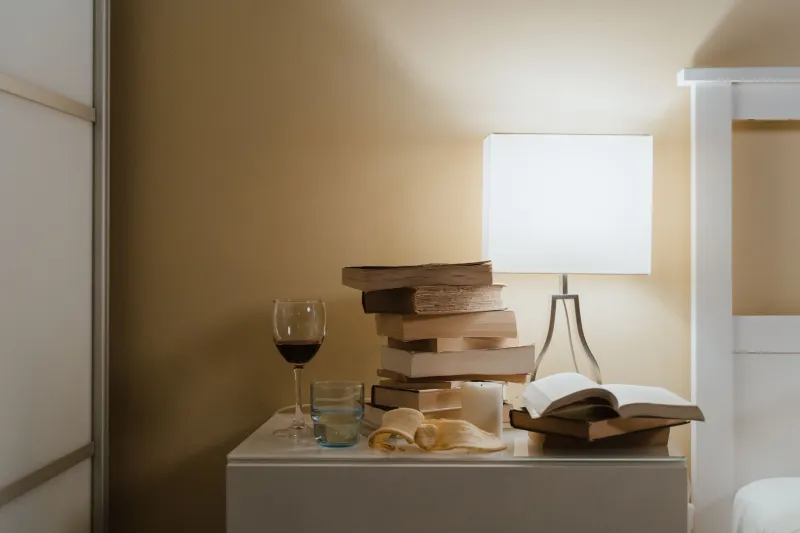
Winter light through a UK flat window is weak and short. The answer is not one bright overhead bulb; it is two or three small, warm sources at different heights. A clip-on picture light aimed at the wall above the sill, a rechargeable candle in a jam jar, a short string of fairy lights tucked into a glass vase. Warm white, not cool white. Nothing that needs drilling, nothing that trails a cable across a walkway.
A plug-in lamp with a slender cable can be tucked behind a curtain and switched on at 4pm, which is roughly when November gives up. The point is not to light the room. The point is to make the ledge feel like it is holding a little pocket of evening, even when the sky outside is the colour of a wet flannel.
Forced bulbs: the winter garden that fits in a jam jar
This is the closest thing to gardening a flat windowsill can offer. Hyacinths are the classic: a glass vase, water just below the base of the bulb, a cool dark cupboard for six to eight weeks until roots fill the glass, then bring them out to the light. Paperwhites will force in a shallow bowl of pebbles and water in four to six weeks. Muscari — grape hyacinths — are small enough for a stoneware cup and smell like a spring that has not arrived yet.
Start one pot every fortnight from late October to early January and you get scent into February. Keep them cool once they are out; a warm windowsill makes them leggy and floppy. Turn the pots a quarter-turn every few days so they do not lean into the glass like commuters on a Tuesday train.
Tiny greenery that forgives a cold ledge
Basil and mint will sulk. They want summer heat and strong light. What works in a cold, bright-ish window in winter is smaller and tougher: a little ivy, mind-your-own-business, a small fern, a spider plant pup in a tumbler. Water sparingly — winter light is weak and wet roots rot. Group two or three pots together so they make a little microclimate, but keep each one on its own saucer.
The aim is not a jungle. It is three or four living things that make you look up from the kettle and remember there is a world outside the radiator.
Seven affordable UK finds for the ledge
- Shallow terracotta saucers — a garden centre or hardware shop, £2–4 each. Buy more than you need. They are the least glamorous and most useful thing on this list.
- A clip-on warm-white LED picture light — John Lewis or Dunelm, £15–25. No drilling, no bracket, no landlord conversation.
- A glass hyacinth vase — IKEA or a garden centre, £5–8. The narrow neck holds the bulb above the water.
- A small stoneware cup or tumbler — charity shop or Muji, £3–6. For muscari or a single paperwhite.
- A British beeswax candle — farmers' market or an independent maker, £12–18. Warm light and a wick to trim on Sundays.
- A wool felt mat or trivet — Dunelm or an independent, £5–8. It absorbs drips and protects the paint.
- Rechargeable battery fairy lights — £8–12 on most UK high streets. No socket, no cable, no trailing flex across the sill.
The Sunday five-minute ledge ritual
Sunday morning, before the kettle goes on. One: wipe the glass and sill dry with a microfibre cloth. Two: check every saucer and tip away any standing water. Three: turn each pot a quarter-turn. Four: pinch off anything yellow or slimy. Five: water only the plants that are properly dry. Six: trim the candle wick. Seven: open the window for two minutes if the weather allows, then shut it and walk away.
That is it. Five minutes, once a week, and the ledge stays a garden rather than a small damp problem with decorative intentions.
What not to put there
Books. Wooden frames. Anything electrical that is not designed for a bathroom. Anything porous that you love. A windowsill in winter is a wet, cold, bright place; treat it like a shelf with weather.
The garden at No. 67 is the size of a tea tray. It has a saucer, a bulb, a candle and a wool mat. It is not much. But on a dark Tuesday in January, when the window is black by half past four, it is the part of the flat that says spring is still on the way.