The Sixty-Minute Fitting Room: A Winter Try-On Ritual for Small Flats
Late November has a particular smell in a small flat: cardboard, courier tape and the faint whiff of indecision. The parcels arrive because the sales do, and because the cold arrives faster than the coat you meant to replace. At No. 67, I have learned that a delivery is not a purchase until it has survived an hour in the hallway. The try-on hour is my way of making that hour count.
Before the timer: make the hallway the fitting room
I clear the floor first. Not the whole flat — just the strip between the front door and the mirror. The returns bag goes by the door, with the labels and tape I will need later. Scissors stay on the shoe shelf. The phone timer is set for sixty minutes and left face-up so I cannot pretend I have not seen it.
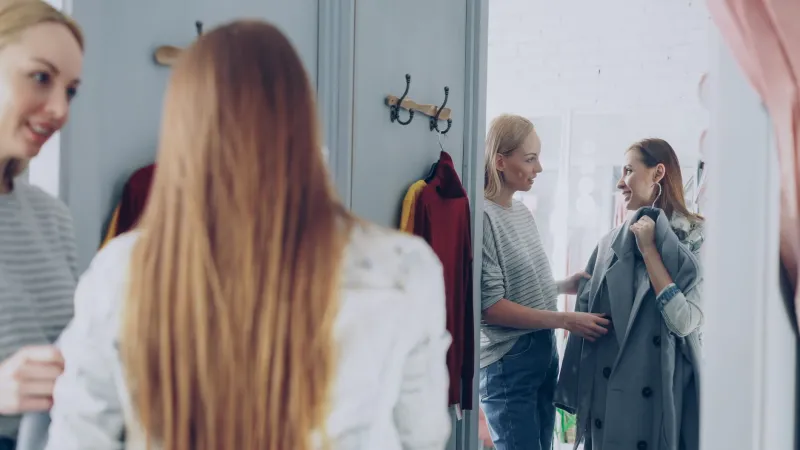
The hallway mirror does the real work. It is the only full-length view in the flat, and it shows the back of a coat in the same unforgiving light as the front. The front room is for living, not auditioning. Keeping the try-on hour in the hallway stops it turning into an afternoon.
And the tags stay on. This is not a styling session; it is a test. Tags on means the decision is still open.
Minutes 0–12: the light test
Late-autumn light is a trickster. A jumper can look oatmeal at the window, grey under the ceiling bulb and faintly green in the kitchen. So I check the new piece in the light I actually live in: the overhead light, the lamp by the sofa, the window at three in the afternoon when the sun is already thinking about leaving.
I look at the collar, the cuffs and the hem. I turn around. I sit down on the hall floor and stand up again, because a winter knit that rides up every time you move is not a winter knit; it is a fidget.
This is also the moment to notice anything that will annoy me later: a scratchy label, a zip that catches, a buttonhole that needs two hands and good intentions.
Minutes 12–30: the layering exam
Winter clothes have to work in company. I put the new piece over the base layer I actually wear — usually a thin merino long-sleeve — then add the coat I actually leave the house in. Not the coat I would wear in a magazine; the one with the bus pass in the pocket.
I raise my arms. I reach for the top shelf. I do up an imaginary bike lock. I check the shoulder seam, the sleeve length with gloves on, and whether the whole thing bunches at the elbow when I bend.
If it only works alone, it is a costume. If it needs a different bra, a different coat and a different life, it is a return.
Minutes 30–45: the repeat test
This is the part that saves the most space. I choose three outfits already in rotation: the Thursday work outfit, the Saturday market outfit, the evening at a friend's. Real outfits, not dream ones.
For each, I ask a simple question: does this new piece improve the outfit, or just complicate it? If I need to buy something else to make it work — a specific boot, a different bag, a slip — that is not a purchase. That is a project. Projects belong on a list, not on the floor of a small flat.
The repeat test also catches the thing I am most likely to forget: whether I would wear it twice in a week. If the answer is no, it had better be excellent. If the answer is yes, it has already started earning its hanger.
Minutes 45–55: the home test
Every item in a small flat must have an address. Hanger? Shelf? Drawer? If the answer is 'on the chair for now', the answer is no.
I am strict about bulky knits and coats because they take up the most room and are the hardest to ignore. If a new jumper needs a special hanger, will it get one? If it needs ironing every wear, am I honestly going to iron it? If it sheds on everything, can I live with that?
This is not about being joyless. It is about being fair to the thing. A beautiful piece with nowhere to live becomes clutter with a nice label.
Minutes 55–60: decide and dispatch
When the timer sounds, there are only two verdicts: keep or return. 'Maybe' is what colonises the floor. 'I'll think about it' is how a return window quietly closes.
If I am uncertain about fit, I return it. If I am uncertain about colour, I return it. If I am uncertain because I want to be a person who wears it, I return it. The returns go straight into the bag by the door, labels on, ready for the morning. The keepers get their tags removed and their place in the wardrobe. I note the return-by date on my phone before I do anything else.
The bag leaves the next day. That is the whole point of the hour: it ends with an empty hallway, not a new pile.
Why the hour works
Small flats do not have room for maybe. A maybe purchase takes floor space, mental space and drawer space, and it makes every other decision harder. The try-on hour is not about being ruthless for the sake of it. It is about giving a new thing one honest hour of real life before it is allowed to stay.
It also protects the return window. Online shopping season is designed to make returning feel like effort; a fixed hour makes it a habit. The hallway mirror has become the most honest fitting room I own. The timer is the assistant. The returns bag by the door is the exit.