Nothing Saved for Best: Why Tuesday Deserves the Good Plates
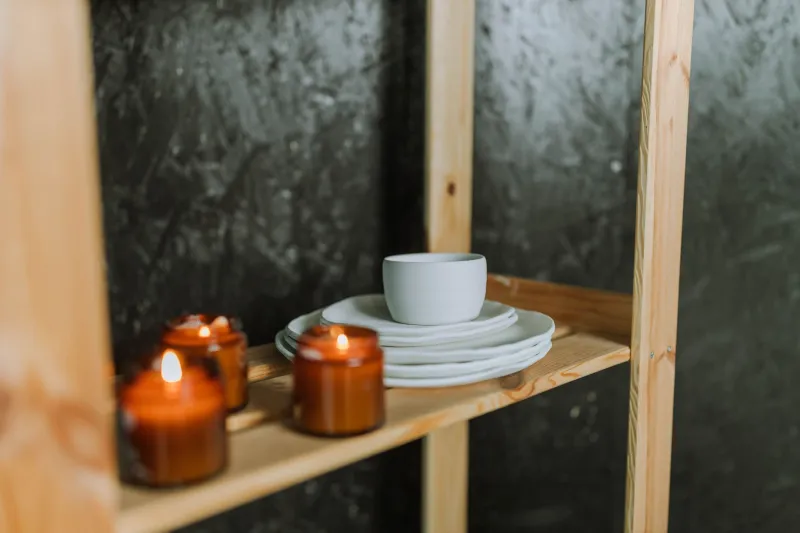
It is a Tuesday in November. The light has gone by half four, the boiler is doing its clanking warm-up, and I am eating a bowl of pasta off a plate that was, technically, a wedding present. There is a candle lit on the windowsill that cost more than the pasta did. Nothing about the evening is special, and that is precisely the point.
For years I did the opposite. The plates lived in the top cupboard under a tea towel. The nice candle sat on the shelf with an untrimmed wick, waiting for guests who came roughly four times a year. The good knit stayed folded in a drawer because a trip to the shop did not feel like an occasion. Then I moved into a flat where the kitchen is one wall, the storage is one cupboard, and the arithmetic stopped working.
A small flat charges rent on everything it holds
This is the argument I keep coming back to, and it is less romantic than it sounds. In a big house, a cupboard of unused things is a mild irritation. In a small flat, it is a tax. Every plate you never eat off, every candle you never burn, every jumper you never wear is quietly occupying floor area you are paying for monthly. You are, in effect, renting a shrine to your own good intentions.
Once I framed it that way, the sentimentality wore off fast. If something is in the flat, it should be earning its keep. The good plates are not heirlooms in a museum; they are crockery, and crockery has one job.
The plates were always meant to be washed
The worry, of course, is damage. Chips. The dishwasher. That specific anxiety about the hand-painted rim from a pottery studio in Stoke that cost more than the rest of the cupboard combined.
Here is what I have learned, mostly by dropping things. Most decent stoneware is tougher than we give it credit for. Check the maker's guidance before you commit, but a surprising amount of everyday china is dishwasher-safe on a low setting, and the ones that are not tend to be the ones you would not use anyway. As for chips — a chipped plate is still a plate. It holds pasta exactly as well as it did before, and slightly better than the one still in its wrapper.
The practical fix is to stop buying in sets of eight. Buy four. Buy two. Then, when one goes, replace it with a single plate from the same range or something deliberately mismatched from a charity shop. A stack of non-matching plates looks far more interesting on an open shelf than a uniform set, and it removes the fear of breaking up the family. John Lewis and Emma Bridgewater both sell singles; so does almost every small pottery on Instagram.
A candle is not a decoration
I have a rule now: no candle enters this flat unless it is going to be burned to the bottom of the tin. That sounds austere. It is actually the opposite.
Think about the cost per evening. A decent small-batch candle — St Eval, The Botanical Candle Co., any of the makers you find at a weekend market — runs somewhere between twelve and thirty pounds. Burned properly, two hours at a time so the wax pools evenly, that is perhaps twenty evenings of a room that feels warmer than the radiator can manage on its own in February. Twenty evenings for the price of a round of drinks. Nothing in this flat works harder.
The trick is placement. Put it where you will actually see it, not where it looks best in a photograph. Mine lives on the kitchen windowsill, next to the washing-up liquid, which is not glamorous and is exactly why it gets lit. If it were on a shelf in the sitting room I would forget it existed.
The jumper you are saving is just getting older
I have a cream cable knit that I spent too much money on and then refused to wear for a year, on the grounds that it was 'too nice' for the school run, the supermarket, the tip. When I finally pulled it out, it had picked up the faint mustiness of a drawer and a moth had been at one sleeve.
Wear the jumper. Pilling is not a moral failure and a knit that shows evidence of being loved is more attractive than one preserved in plastic. Buy a cashmere comb for eight pounds, learn to fold rather than hang, wash on wool cycle with the good detergent and dry flat on a towel. All of that is cheaper and easier than the guilt of a garment you never touch.
Considered, not precious
The line between a ritual and a fuss is thinner than it looks, so here is how I keep on the right side of it.
- One object per ritual. The good plate. The lit candle. The nice glass. Not all three plus napkins plus a centrepiece.
- A cloth napkin, occasionally. Not ironed. Just there.
- The two-guest rule. If the table setting looks like it needs a reason, it does not belong on a Tuesday.
- Let things live where they are used. A decanted jar of pasta on the worktop gets used; the same jar on a high shelf becomes furniture.
None of this requires a bigger flat or a bigger budget. It requires deciding that an ordinary evening is a legitimate use of an object, which is a surprisingly difficult thing to decide the first time and a very easy thing to keep deciding after that.
What waiting actually costs
Nothing in my cupboard ever thanked me for saving it. The candle went dusty. The plates survived, untouched, and then got used anyway when we moved and I ran out of boxes. The only thing that changed was the number of Tuesdays I spent eating off the boring plates while the good ones waited for a life that had already arrived.
At number 67, on a wet Tuesday in November, the good plates are in the dishwasher and the second-best candle is lit. It is not an occasion. That is the whole argument.